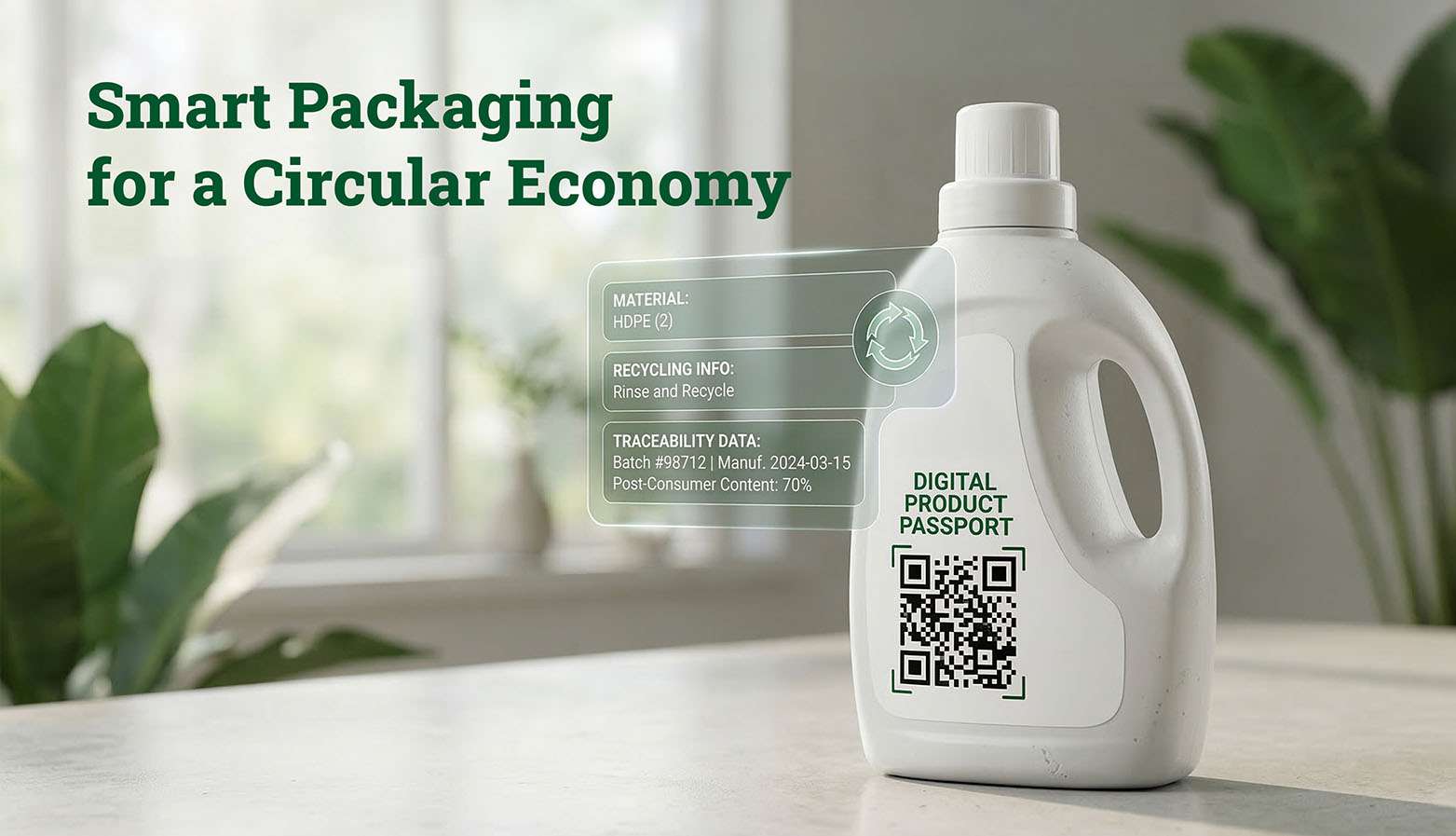
Smart packaging is now a powerful force in the world of global logistics and sustainability, which has rapidly evolved and defined the path that connects offline products with online information and intelligence. In contrast with the traditional packaging that can fulfill only one role of containment and protection, smart packaging implies the use of advanced technologies, including QR code, RFID tags, and special chemical sensors, to provide real-time information on the product path, status, and origin. The circular economy is one place where this innovation proves especially important because the capacity to trace, sort and recover materials in an efficient way is what boils down to the difference between a successful recycling loop and the one-way trip to the landfill. With a digital identity in every intelligent package, brand names can give consumers the power to dispose of their products the way they want, enable recyclers to sort their products much faster, and enable complete transparency in supply chains. This is because, by 2026, smart packaging is not an additional feature of luxury goods, but an operational feature of the Extended Producer Responsibility (EPR) and tracing the carbon footprint requirements. To a clever packaging company, it is difficult to make sure that such electronic or even chemical additions do not compromise the underlying recyclability of the material. When done rightly, smart package is a sort of a molecular passport ensuring that all the grams of plastic, paper, or metals can be located, collected, and reused, and so-called trash turns out to be a trackable and useful industrial material in the subsequent manufacturing cycles.
Introduction
With the future of the world being more sustainable, we can see that the shift of a passive smart package to an active one in the supply chain is not far behind us. Such a change enables the consumer and the brand to have some form of interaction never before achievable, and the smart package can be viewed as an educational and environmental action tool.
These technologies are to be implemented so as to guarantee:
Improved Traceability
The knowledge of the exact place of manufacturing a product and its route.
Waste Reduction
Notifying customers when a product is expired in order to avoid disposing of them unnecessarily.
Interactive Engagement
This is the provision of direct access to the recycling facilities or take-back programs.
What is Smart Packaging?
A smart packaging system at its base is a catchphrase that encompasses both an active and an intelligent functionality. Active packaging works with the contents to keep them longer in shelf life but an intelligent smart packaging system is aimed at communication and transmission of data.
To fully grasp the smart packaging system, one should consider the solution of the invisibility of waste. With the help of an additional digital voice of a bottle or a pouch, we can make sure that it gets sorted at a material recovery facility (MRF) in the first place, and this is what is meant by any forward-thinking smart packaging company.
Types of Smart Packaging
The different types of smart packaging technology available will have to be known by the brands to settle on the appropriate smart packaging solution. The categories of smart packaging are usually separated in terms of the main purpose:
Active Packaging
It involves the use of moisture regulators or oxygen scavengers to ensure that the food lasts longer.
Intelligent Packaging
External indicators or sensors are used to check temperature, freshness or tampering. Connected Packaging: Uses QR, NFC or AR to enable a physical package communication to a smartphone application.
Smart packaging company are now scurrying to come up with the most affordable and non-harmful forms of smart packaging to achieve the 2026 sustainability objectives.
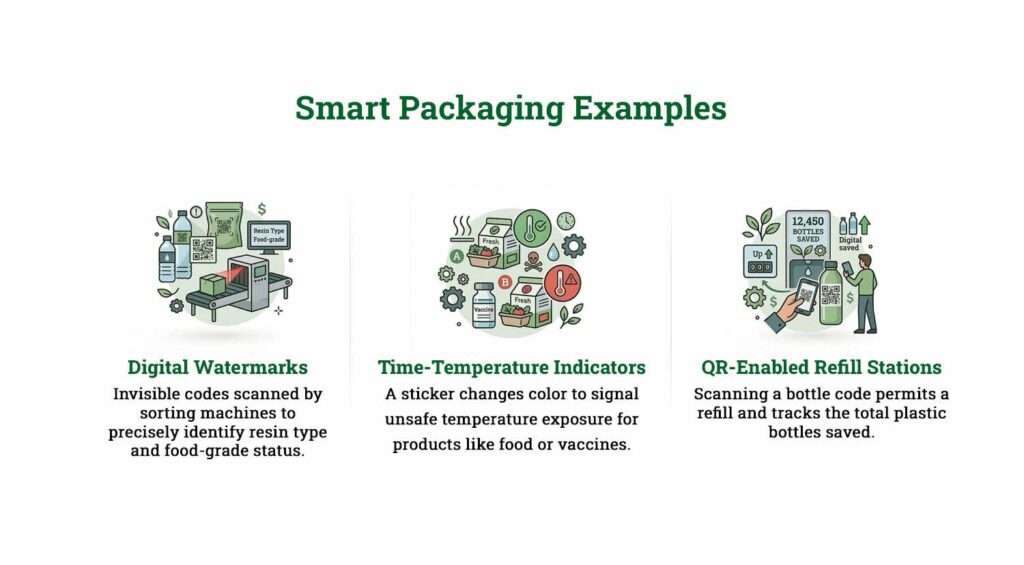
Smart Packaging Examples
The fact that one can see a smart packaging solution in action contributes to demonstrating its worth. These smart packaging examples demonstrate that technology can be used to address real-life issues within the circular economy:
Digital Watermarks
Invisible type of code can be identified by high-speed sorting machine to determine the precise resin type and state of food grade.
Time-Temperature Indicators
Stickers, which turn color when a vaccine or food product has been exposed to unsafe temperatures.
QR-Enabled Refill Stations
A refill station is a smart packaging system that permits a refill by scanning the code on a bottle, which keeps track of the number of plastic bottles saved.
This means that the value of the waste by adding intelligence to the material rises considerably, as these smart packaging examples show.
Benefits of Smart Packaging in a Circular Economy
Smart packaging has many advantages that are not limited to checkout. The following are the benefits of smart packaging, which are unlocked by incorporating smartness in the design:
Maximum Recycling
The machines have the ability to identify the material with 99 percent accuracy by reading embedded data.
Less Food Waste
Freshness sensors will also monitor food in real-time to stop its untimely disposal.
Anti-Counterfeiting
Protection of authenticity of the products which is one of the major smart packaging uses in pharmaceuticals.
Consumer Empowerment
Providing the instructions on how to recycle in the specific local municipality of the user by a quick scan.
Smart Packaging Uses
Smart packaging uses are being adopted in all industries, including the beauty and heavy industry, in the current market.Companies can minimize their operation inefficiencies by finding the appropriate uses of smart packaging.
The typical uses are:
- FMCG: (Monitoring the shelf-age) of goods to maximise stock turnover.
- Logistics: RFID can be used to operate a real-time inventory without opening boxes.
- Sustainability: Audit of the quality of PCR (Post-Consumer Recycled) content in a container is one of the most important smart packaging applications.
The value of smart packaging is that it can offer a “Chain of Custody” of materials, which is crucial to global circularity.
Importance of Smart Packaging for the Future
The importance of smart packaging will increase further in the world as we see stricter laws over plastic waste. A Digital Product Passport is becoming a legal requirement in most areas, so the relevance of smart packaging is one of both legal and ethical concerns. The circular economy cannot even grow to the level it needs to prevent plastic pollution without the information that these systems provide.
Role of Smart Packaging Companies in Driving Circularity
One of the smart packaging companies is a tech integrator. It is the duty of these companies to make sure that sensors and tags themselves do not become contaminants. A smart packaging company will also avoid making the intelligence prevent the recycling process by designing tags that can be washed away or the tags are produced by using the same polymer as the bottle.
Conclusion
The age of the dumb packaging is coming to pass. Through adopting smarter packaging and the awareness of the various forms of smarter packaging, we can eventually consider each container as a resource of valuable data in a circular loop. The keys to a sustainable 2026 are the benefits of smart packaging, whether it is a waste reduction tool or recycling efficiently. The more examples of smart packaging we apply to India and the world, the closer we will get to a truly waste-free world.
FAQ's
How does smart packaging support recycling?
It provides digital “markers” that automated sorting facilities use to identify materials more accurately than human eyes or basic sensors, ensuring higher purity in recycled resins.
What industries benefit the most from smart packaging?
The food and beverage, pharmaceutical, and luxury goods industries benefit most due to requirements for freshness monitoring, safety, and authenticity.
Is smart packaging environmentally friendly?
It is environmentally friendly if the technology is designed for the circular economy. However, it requires a smart packaging company to ensure that the electronic components are easily removable or recyclable.
Making recycled packaging the norm.
CITATIONS:
- AIPIA. (Active & Intelligent Packaging Industry Association). Trends in Smart Systems 2025.
- Journal of Cleaner Production. (2025). Smart Packaging as a Facilitator for the Circular Economy.
- Smithers. The Future of Smart Packaging to 2030.
 World Cleanup Day 2026: Date, Theme and How You Can Take Part
 What is Polypropylene Plastic?
 What Is a Carbon Footprint? Meaning, Calculation & How to Reduce It
 Life Cycle Assessment (LCA): Steps, Phases, Standards & a Real Example
 Types of Plastic Recycling: Methods, Categories, and Recycled Plastic Types Explained